
Description
PrymaLab · Research Use Only
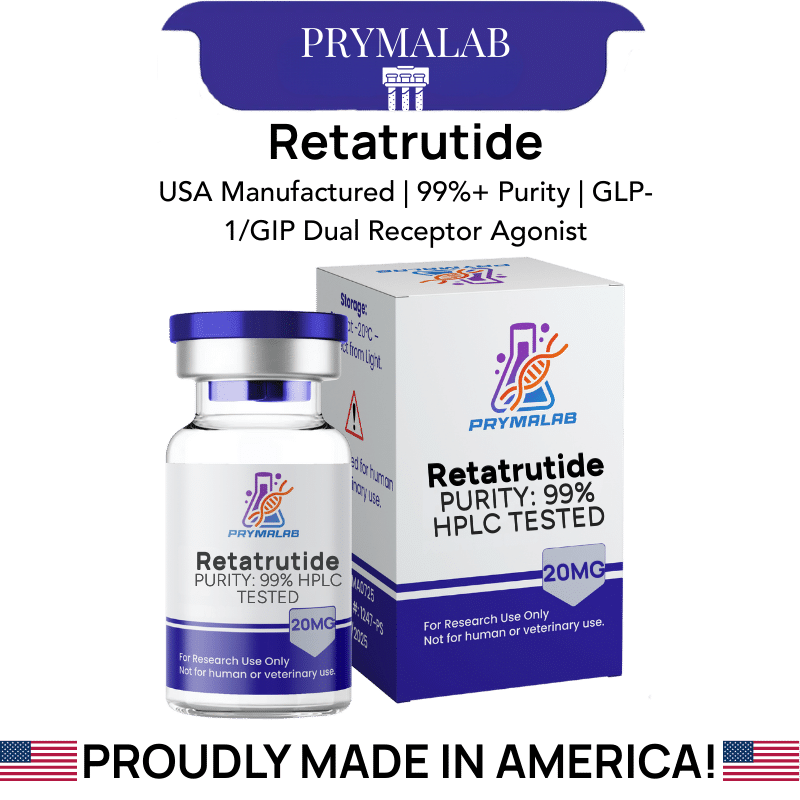
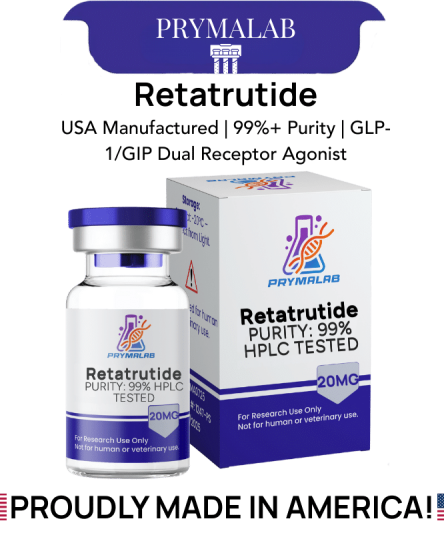
Retatrutide 20mg
LY3437943 · C20 diacid conjugate · 39 residues
Retatrutide 20mg is a lyophilized vial of LY3437943, CAS 2381089-83-2. The lysine 17 side chain carries a PEG2 spacer, a gamma-glutamate linker and a twenty-carbon diacid, and that assembly is what governs how long the molecule persists in a biological system.
Specification Table
| Property | Value |
|---|---|
| Compound | Retatrutide |
| Development code | LY3437943 |
| CAS number | 2381089-83-2 |
| Vial content | 20 mg lyophilized powder |
| Molar content at MW 4894.58 | Approximately 4.09 µmol |
| Conjugation site | Lysine 17 side chain |
| Conjugation components | PEG2 spacer, γ-glutamate linker, eicosanedioic acid |
| Diacid chain length | Twenty carbons, dicarboxylic |
| Molecular formula | C228H350N48O66 |
| Molecular weight | Contested. 4894.58 and 4731.33 both circulate. See the note on the 5mg page |
| Residue count | 39 |
| C-terminus | Amidated |
| Peptide backbone | Based on the GIP sequence rather than GLP-1 |
| Non-coded residue, position 2 | α-aminoisobutyric acid (Aib) |
| Non-coded residue, position 13 | α-methyl-leucine |
| Non-coded residue, position 20 | α-aminoisobutyric acid (Aib) |
| Lipid conjugation | Lysine 17 side chain bears PEG2-γ-Glu-eicosanedioic acid |
| Molecular targets | GIP receptor, GLP-1 receptor, glucagon receptor |
| Reported EC50, GIPR | 0.0643 nM |
| Reported EC50, GLP-1R | 0.775 nM |
| Reported EC50, GCGR | 5.79 nM |
| Originating organisation | Eli Lilly |
| Appearance | White lyophilized powder |
| Purity | Per lot-specific certificate of analysis |
| Solubility | Water soluble. Slightly alkaline buffer aids dissolution |
| Storage, lyophilized | -20°C, protected from light and moisture |
| Storage, reconstituted | 2-8°C, protected from light |
| Regulatory status | Investigational. No approved formulation in any jurisdiction |
What Does the Retatrutide Fatty Acid Conjugation Do?
The lipid assembly on Retatrutide 20mg at lysine 17 is the single most consequential modification on this molecule, and it works through a mechanism that is often described loosely.
The conjugate is not simply a fatty acid. It is a three-part assembly: a short polyethylene glycol spacer, a gamma-linked glutamate, and a twenty-carbon dicarboxylic acid at the end. Each element does a different job.
The diacid binds serum albumin non-covalently, in the hydrophobic pockets albumin uses for endogenous fatty acids, and a molecule bound to albumin is far too large for renal filtration, so clearance slows dramatically.
The gamma-glutamate linker positions the lipid at a defined distance from the peptide backbone. Too close and the lipid interferes with receptor engagement. Too far and albumin binding weakens. That spacing is the result of medicinal chemistry optimisation rather than an arbitrary choice.
The PEG2 spacer adds hydrophilicity immediately adjacent to the attachment point, which offsets the solubility penalty a long hydrocarbon chain would otherwise impose.
The choice of a dicarboxylic acid rather than a monoacid matters too. The free carboxylate at the distal end reduces the tendency toward non-specific membrane insertion while preserving albumin affinity.
What Is the Reported Retatrutide Half Life?
For Retatrutide 20mg, duration is the property the conjugation was designed to deliver, and the published figures make the design intent legible.
Clinical pharmacokinetic work reports an elimination half-life supporting once-weekly exposure intervals in humans, broadly in the range of six days. Urva and colleagues published the early pharmacokinetic characterisation.
Compare that against native GLP-1, which has a plasma half-life measured in a couple of minutes because dipeptidyl peptidase-4 cleaves it almost immediately. The gap between minutes and days is roughly four orders of magnitude.
Two modifications between them produce that gap. Aib at position 2 blocks the protease, and the albumin-binding conjugate blocks renal clearance. Neither alone would be sufficient.
For laboratory work the practical implication concerns matrix. In a protein-free buffer there is no albumin to bind, so the conjugation contributes nothing to stability and the molecule behaves like an unconjugated peptide of the same sequence.
That means a stability finding obtained in buffer does not transfer to a finding obtained in serum, and the direction of the difference is large rather than marginal.
How Should Albumin Binding Be Handled Experimentally?
The same property that makes this molecule long-acting makes it awkward to work with, and the awkwardness is systematic rather than occasional.
In any medium containing albumin, a substantial fraction of the compound is bound at equilibrium. The free concentration, which is what engages receptors, is lower than the nominal concentration by an amount that depends on albumin concentration.
Ten percent serum, one percent bovine serum albumin and serum-free medium therefore give three different free concentrations from the same nominal addition. Comparing across them without measuring the free fraction compares three different experiments.
Equilibrium dialysis and ultrafiltration both measure free fraction directly. Neither is difficult and both are worth doing once per medium formulation rather than once per experiment.
The alternative is to work serum-free throughout and accept that the conjugation is inert under those conditions, and that is a legitimate choice provided it is stated, because it changes what the result means.
Reporting the albumin content of the medium is not optional detail for this compound. It is part of the concentration, and omitting it makes a concentration figure uninterpretable.
What Does Retatrutide Triple Agonist Actually Describe?
The phrase is used as a category label and it describes a specific design philosophy worth understanding.
A unimolecular multi-agonist is one molecule engaging several receptors, as opposed to a combination product delivering several molecules. The distinction matters because a single molecule has one pharmacokinetic profile rather than several overlapping ones.
Finan and colleagues established the approach in Nature Medicine in 2015, describing unimolecular triple agonists at these same three receptors before retatrutide existed. The concept preceded this specific compound by several years.
The engineering problem is that three receptors demand different things from a ligand. Optimising affinity at one frequently costs affinity at another, and the reported EC50 spread across GIPR, GLP-1R and GCGR reflects where that compromise landed.
Retatrutide is not equipotent across its three targets and was never intended to be. Reported values span roughly two orders of magnitude, from 0.0643 nM at GIPR to 5.79 nM at GCGR.
Describing it as a balanced triple agonist therefore misstates it. The balance is deliberate and uneven, and reproducing any published finding requires matching the concentration rather than the label.
Where Should Retatrutide Buy Decisions Focus?
For a compound under active development by a named manufacturer, the questions worth asking a supplier are narrow and answerable.
The lipid conjugation is the first. It is the most complex part of the synthesis, the most likely thing to be incomplete, and the most consequential thing to get wrong. A preparation missing it weighs several hundred daltons less and has none of the duration the molecule is valued for.
The three non-coded residues are the second. Aib at positions 2 and 20 and alpha-methyl-leucine at position 13 require non-standard building blocks, and a shortcut synthesis substituting coded residues produces a peptide of correct length with entirely different protease resistance.
Measured mass rather than a catalogue figure is the third, given the molecular weight discrepancy documented on the 5mg page.
Net peptide content is the fourth, because two adjacent lysines at positions 16 and 17 make this sequence a strong trifluoroacetate binder after standard cleavage chemistry.
A supplier able to answer all four has characterised their material. One quoting only a purity percentage has not.
What Does Retatrutide 20mg Supply and Suit?
Four point zero nine micromoles is a working quantity rather than a stockpile, and it sits at a useful point in the range.
Retatrutide 20mg covers a full concentration series across four orders of magnitude in triplicate, with three receptor arms and vehicle controls, several times over. Material is rarely the limiting factor at sub-nanomolar potency.
What it suits particularly is a programme running long enough to want lot continuity without committing to a bulk fill. Retatrutide 20mg holds synthesis variation constant across a defined study while remaining small enough to consume promptly.
It also suits parallel work. Where two laboratories or two assay systems need the same lot, one vial of this size divides cleanly and removes material as an explanation for any divergence.
Against that, animal work will consume it quickly, and the larger fills exist for exactly that case.
How Should the Vial Be Reconstituted and Held?
Retatrutide 20mg is approximately 4.09 micromoles on the higher molecular weight figure, which is a substantial quantity at the concentrations these receptors respond to.
Reconstituted into 4 ml the vial gives roughly 1.02 mM, matching what the 10mg format produces in 2 ml and keeping dilution arithmetic transferable across the ladder.
Add diluent slowly down the vial wall. A lipidated peptide with helical character aggregates readily under agitation, and the lipid tail gives it a mechanism for association that an unconjugated sequence lacks.
Aliquot immediately and freeze. Repeated freeze-thaw drives aggregation harder here than in a plain peptide, because the hydrophobic tail provides a nucleation point.
Use low-binding consumables throughout. The conjugation makes this molecule surface-active, and adsorptive loss at low working concentrations exceeds what the sequence alone would predict.
Hold lyophilized material at -20°C, sealed against light and moisture. Record lot, measured mass, the molecular weight used for calculation, diluent, volume, concentration and date.
One further note on the conjugate and analysis. Because the lipid assembly contributes several hundred daltons, an incompletely conjugated preparation is obvious on a mass spectrum in a way that most synthesis defects are not.
That makes it the easiest serious defect to rule out, and there is no reason to accept a certificate that does not.
It also means a supplier reporting only a chromatographic purity figure has skipped the check that matters most for this molecule.
A closing note on the PEG spacer. It is short, only two ethylene glycol units, and that brevity is deliberate rather than incidental.
Longer spacers weaken albumin binding by letting the lipid sit too far from the backbone to be presented properly, so the length is an optimised parameter rather than a filler element.
Published Literature
References verified against the publisher record. The pharmacokinetic and receptor characterisation figures quoted come from the primary literature rather than secondary summaries.
- Coskun T, Urva S, Roell WC, Qu H, Loghin C, Moyers JS, O’Farrell LS, Briere DA, Sloop KW, Thomas MK, Pirro V, Wainscott DB, Willard FS, Abernathy M, Morford L, Du Y, Benson C, Gimeno RE, Haupt A, Coskun T. Cell Metabolism. 2022;34(9):1234-1247.
- Urva S, Coskun T, Neff LM, Yeo KP, Loghin C, Ma X, Landry J, Bray R, Milicevic Z, Haupt A. The Lancet. 2022;400(10366):1869-1881.
- Jastreboff AM, Kaplan LM, Frias JP, Wu Q, Du Y, Gurbuz S, Coskun T, Haupt A, Milicevic Z, Hartman ML. New England Journal of Medicine. 2023;389(6):514-526.
- Willard FS, Douros JD, Gabe MB, Showalter AD, Wainscott DB, Suter TM, Capozzi ME, van der Velden WJ, Stutsman C, Cardona GR, et al. JCI Insight. 2020;5(17):e140532.
- Finan B, Yang B, Ottaway N, Smiley DL, Ma T, Clemmensen C, Chabenne J, Zhang L, Habegger KM, Fischer K, et al. Nature Medicine. 2015;21(1):27-36.
Frequently Asked Questions
What is Retatrutide 20mg?
A lyophilized vial of LY3437943, CAS 2381089-83-2, a 39-residue peptide bearing a lipid conjugate at lysine 17. Retatrutide 20mg is approximately 4.09 micromoles. Sold for laboratory research alone, with no approved formulation in any jurisdiction.
What is the conjugate made of?
Three parts: a short polyethylene glycol spacer, a gamma-linked glutamate, and a twenty-carbon dicarboxylic acid, and each element does a different job, and describing it simply as a fatty acid understates the design.
How does it extend duration?
The diacid binds serum albumin non-covalently in the hydrophobic pockets albumin uses for endogenous fatty acids, and a molecule bound to albumin is far too large for renal filtration, so clearance slows dramatically.
Why a diacid rather than a single acid?
The free carboxylate at the distal end reduces the tendency toward non-specific membrane insertion while preserving albumin affinity. A monoacid would bind albumin but partition into membranes more readily.
What is the reported half life?
Clinical pharmacokinetic work reports an elimination half-life supporting weekly exposure intervals, broadly in the range of six days. Native GLP-1, by comparison, has a plasma half-life measured in a couple of minutes.
Which modifications produce that gap?
Two, and neither alone would suffice. Aib at position 2 blocks dipeptidyl peptidase-4 cleavage, and the albumin-binding conjugate blocks renal clearance. Together they span roughly four orders of magnitude.
Does the conjugation help in buffer?
No. In protein-free buffer there is no albumin to bind, so the conjugation contributes nothing to stability and the molecule behaves like an unconjugated peptide of the same sequence. Stability findings do not transfer between buffer and serum.
How much does albumin lower the free concentration?
Substantially, and by an amount depending on albumin content. Ten percent serum, one percent bovine serum albumin and serum-free medium give three different free concentrations from the same nominal addition.
How is free fraction measured?
Equilibrium dialysis or ultrafiltration. Neither is difficult, and both are worth doing once per medium formulation rather than once per experiment. Reporting albumin content is part of reporting the concentration for this compound.
Is it equally potent at all three receptors?
No, and it was never intended to be. Reported EC50 values span roughly two orders of magnitude, from 0.0643 nanomolar at GIPR to 5.79 at GCGR. Calling it a balanced triple agonist misstates the design.
What should a supplier be able to confirm?
The lipid conjugation, the three non-coded residues, the measured mass, and net peptide content. The conjugation is the most complex part of the synthesis and the most consequential thing to get wrong.
Compliance Statement
Retatrutide 20mg is sold exclusively for laboratory research use. It is not a drug, food, or cosmetic product, and it is not a dietary product of any kind. It is not approved by the FDA or any comparable authority for human or veterinary use, it is an investigational compound with no approved formulation in any jurisdiction, and material supplied as a research chemical is not a clinical product. This product is not intended to diagnose, treat, cure, or prevent any disease. It must not be given to humans or animals. Purchase is restricted to qualified researchers and institutions operating within applicable laws. All handling is the responsibility of the purchasing laboratory.











19 reviews for Retatrutide 20mg